

Trading Chart Patterns Guide with PDF Resources
📈 Learn to spot key trading chart patterns for smarter market moves. Discover reliable formations, real examples, plus where to get practical PDF resources. 📝
Edited By
Henry Patel
Trading chart patterns act as a practical language for interpreting price movements in financial markets. Whether you’re trading stocks, currencies, or commodities, spotting these patterns can give you a leg up on predicting where prices might head next.
Charts chart out supply and demand at work — when buyers and sellers sway prices back and forth, recognizable shapes form. These shapes, known as chart patterns, reflect collective market psychology like fear, greed, and hesitation. Understanding them lets you gauge momentum and possible reversals.

Here’s the bottom line: chart patterns aren’t foolproof, but they’re valuable tools. They help you spot potential entry and exit points by providing visual clues about the market’s balance.
For example, a common pattern like the "head and shoulders" signals a possible trend reversal. Imagine a stock climbing higher but then struggling to push past a peak – the "head" – followed by a lower high, the "right shoulder". That setup often hints the market is ready to shift from a bull run to a downtrend.
Chart patterns split into two main groups:
Continuation patterns signal the trend will likely keep going the same way.
Reversal patterns alert you when a trend could flip direction.
Recognizing these patterns allows traders and investors to plan better trades and manage risks. They’re staples in technical analysis, complementing other tools like volume, moving averages, and indicators.
Knowing how to read chart patterns improves your timing and confidence in market decisions — it's like having a map when you’re navigating tricky terrain.
Over the next sections, we’ll cover key chart patterns, how to spot them, and how to apply them to your trading strategy. This foundation will build your ability to interpret market behavior and act on it wisely.
Trading chart patterns give traders a visual snapshot of how the market behaves over time. Understanding these patterns forms the backbone of technical analysis, helping you spot potential price moves before they happen. For example, observing a clear "double bottom" pattern can indicate where a stock might reverse from a downtrend, offering a smart entry point.
Chart patterns are recognizable shapes or formations created by price movements on a trading chart. They serve as visual cues, highlighting shifts in supply and demand or changes in market sentiment. The main goal is to use these patterns to predict future price directions, helping traders make timely and informed decisions.
Think of them as the market’s body language — subtle signals that hint at what might come next without needing to examine every trade.
Patterns show up when prices move in specific ways over time, forming peaks, troughs, and trendlines. For example, a "head and shoulders" pattern develops when prices create three peaks with the middle peak higher than the others. These formations aren't random — they often reflect collective trader behavior and responses to market events.
Price charts are simply graphical representations of past trades, and these patterns emerge naturally as traders react to news, earnings reports, or other triggers.
Chart patterns help forecast possible price paths based on historical tendencies. If a stock forms a "triangle" pattern, traders often expect a breakout in one direction after a period of consolidation. While patterns don’t guarantee outcomes, they offer a framework to gauge momentum and likely direction.

For instance, spotting a "bull flag" pattern suggests that a bullish move may continue after a brief pause. This can guide a trader on when to jump in or out of a position.
Beyond predicting moves, chart patterns help manage risk. Knowing where a pattern fails — such as a neckline breakout in a head and shoulders formation — allows traders to set stop-loss orders effectively. This limits losses when the market doesn’t act as expected.
Imagine you buy based on a "double bottom" but the price falls below that pattern’s support level. That break signals you to exit, preventing larger losses. Thus, chart patterns not only steer entries and exits but also help protect your capital.
Recognizing and interpreting chart patterns is a practical skill that balances opportunity with caution, making your trading more strategic and less guesswork.
Recognizing common reversal patterns is vital for traders aiming to spot market turns before they happen. These patterns provide clues that the current trend may be losing steam, signaling a potential shift in price direction. By learning to identify them, you gain an edge in timing entry and exit points, which can improve your risk management.
The Head and Shoulders pattern is one of the most reliable reversal setups in trading. It appears as three peaks: a higher peak (the "head") flanked by two lower peaks (the "shoulders"). The line connecting the lows between these peaks is called the "neckline." For example, if a stock rallies to $50, pulls back to $45, then pushes up to $55 before declining again, this forms the head with shoulders around $50 levels.
This pattern typically signals a shift from a bullish to bearish trend. The formation indicates weakening buying power, as the price fails to push higher after the head, hinting that sellers might take control.
Traders watch for a break below the neckline to confirm the pattern and signal a potential sell-off. The volume often rises during this breakdown, providing additional confirmation. For instance, if the neckline sits at $45 and the price dips under this with increasing volume, it's a strong signal to consider exiting long positions or entering shorts.
However, beware of false breakouts. Waiting for a close below the neckline rather than just an intraday move helps avoid premature decisions. Also, setting stop losses slightly above the right shoulder helps control risk in case the pattern fails.
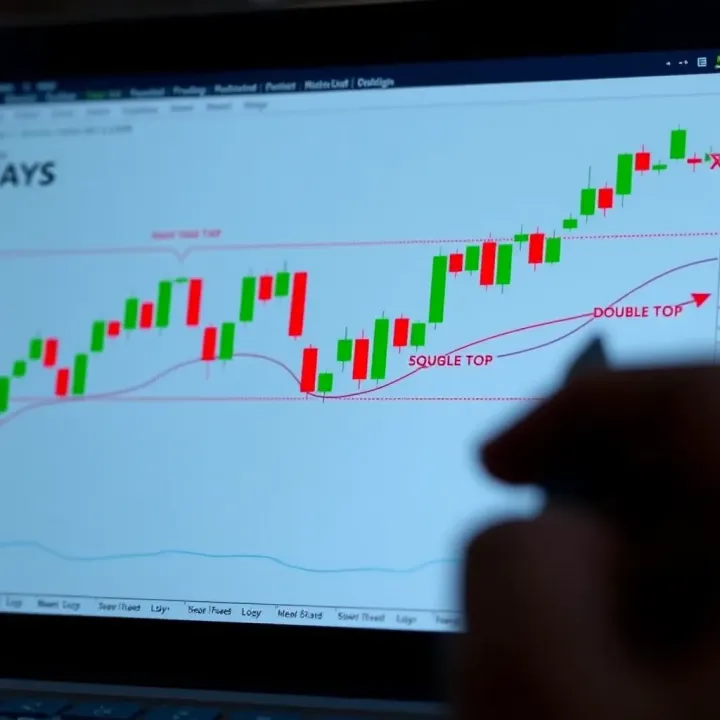
Double tops and double bottoms signal trend reversals through price testing key support or resistance levels twice without breakthrough. A double top forms when an uptrend hits a resistance level, pulls back, then retests that high but fails to climb higher. Conversely, a double bottom appears when a downtrend finds support twice and fails to drop lower.
Imagine a stock rising to $100, dropping to $90, then testing $100 again but retreating. That's a classic double top. Similarly, if it falls to $70, bounces to $80, then drops back to $70 without breaking lower, that’s a double bottom.
These patterns suggest exhaustion in the current trend and a likely shift. Confirmation comes when price breaks the support level (neckline) after a double top or breaks resistance after a double bottom. Traders often use these breakouts as entry points for trades aligned with the new trend direction.
For example, after a double top at $100, a break below $90 signals a potential downtrend. Traders might short the stock with a stop just above $100 to manage risk. In practice, volume usually spikes on the breakout, reinforcing the signal's strength.
Spotting these reversal patterns promptly can help you avoid holding onto losing positions and position yourself to profit from upcoming market moves. Combining pattern recognition with volume and other indicators further boosts reliability.
By understanding the structure and signals behind these common reversal setups, you'll be more equipped to make smarter, timely decisions in dynamic markets.
Continuation patterns signal that a price trend, whether up or down, is likely to keep going after a brief pause. These patterns help traders avoid jumping the gun on a reversal and instead offer cleaner entry points to ride the ongoing trend. By recognizing these formations, you can spot when the market is taking a breather before pushing onward, which is essential for timing trades, managing risk, and optimizing profit potential.
Triangles form when price swings narrow into a tighter range, creating a visual triangle shape. Each type hints at different market psychology. A symmetrical triangle has converging trendlines that squeeze price action into smaller highs and lows, typically signaling indecision. Traders watch for a breakout in either direction, although the prior trend often resumes once the breakout happens.
Ascending triangles show a flat resistance line on top and rising support below. This pattern usually points to buyers gaining strength, as higher lows build pressure for a breakout upward. Descending triangles flip this idea: flat support below and descending resistance overhead, often indicating selling pressure mounting and a likely downward breakout.
When it comes to forecasting, you measure the triangle's widest part to estimate potential price movement post-breakout. For example, if a symmetrical triangle is $5 wide at its base, a breakout might push price $5 above or below the breakout point, giving a target to aim for or set stops around.
Flags and pennants tend to appear after sharp price moves and represent short pauses before the trend keeps moving. Flags look like small rectangular consolidations slanting against the main trend, while pennants resemble tiny symmetrical triangles. Both usually last a few days to a couple of weeks.
These patterns form as traders catch their breath before momentum continues. For instance, after a strong rally, a flag forms when price pulls back just enough to shake out weaker hands without reversing the trend. Once price breaks out of the flag or pennant, the prior move often resumes with similar strength.
Trading with momentum here means you enter as soon as the breakout happens and ride the wave until signs of exhaustion. Many traders combine volume analysis, since rising volume on breakout confirms buying or selling interest, and indicators like RSI to avoid late entries.
Understanding continuation patterns like triangles, flags, and pennants helps you stay on the winning side of the market, especially when most traders misread pauses as reversals.
By paying close attention to these patterns and combining them with volume and other tools, you’ll improve your chances of capturing sustained moves without falling prey to false signals.
Chart patterns provide valuable hints about market direction, but their effectiveness really depends on how you use them. Relying solely on the shapes you see can leave you vulnerable to false signals. The key is to combine pattern recognition with other tools and insights. For example, spotting a head and shoulders pattern is more useful when you also monitor volume dips or spikes. This combined approach boosts your confidence and helps you time trades better.
Volume plays a vital role in validating chart patterns. When a pattern forms, changes in volume can confirm if the move is genuine or likely to fail. Take a breakout from a triangle pattern: if volume surges alongside the price move, it usually confirms strong buying or selling interest. On the other hand, a breakout on low volume might be weak or prone to reversal. Volume acts like a pulse, telling you if the market supports the pattern.
Besides volume, traders often use indicators as a second opinion. Relative Strength Index (RSI) can help spot overbought or oversold conditions, lending clues about when pattern signals might weaken. Moving averages smooth out price action and verify trend direction, reducing the chance of chasing false moves. MACD (Moving Average Convergence Divergence) shows momentum shifts that can align with patterns like flags or pennants. Using these indicators together with chart patterns creates a fuller, clearer picture.
Misreading patterns happens frequently, especially under pressure. A pattern might look perfect at first glance but could be distorted by random price noise or market manipulation. For example, a double top may seem like a sign to sell, but if it lacks a defined neckline or stops just short of a previous peak, it’s likely not reliable. Taking such formations at face value can lead to premature exits or entries.
Ignoring the broader market context is another big pitfall. Chart patterns don’t exist in isolation—they unfold within overall market trends and external events. A bullish flag pattern in a strong uptrend has higher odds of success than the same pattern during a choppy, sideways market. Economic news, earnings reports, and geopolitical factors can override technical signals entirely. So, it’s wise to keep an eye on these external forces when making decisions.
Bottom line: Chart patterns are powerful tools, but their strength lies in how you confirm them and understand the bigger picture. Taking shortcuts or ignoring extra clues often leads to costly mistakes.
By respecting these tips, you’ll improve how you read and react to chart patterns, enhancing your market decisions and overall trading success.
📈 Learn to spot key trading chart patterns for smarter market moves. Discover reliable formations, real examples, plus where to get practical PDF resources. 📝

📊 Discover how to read key chart patterns in trading with our detailed guide and access free PDF downloads to boost your skills in Kenya and beyond.
Master key forex chart patterns 📈 with this practical guide! Learn to spot formations, interpret signals, and boost your trading edge confidently.

📈 Learn to identify key reversal candlestick patterns and improve trading choices in Kenya's markets. Understand their pros, cons, and practical use for smarter investing.
Based on 13 reviews