
Understanding Binary Multiplication Basics
🔢 Explore binary multiplication basics, step-by-step methods, and its role in computing and digital tech, plus tips to optimize this essential process.
Edited By
Isabella Turner
The Label Distribution Protocol (LDP) plays an important role in managing traffic flows across Multiprotocol Label Switching (MPLS) networks. To keep these systems running smoothly, network engineers rely on tools like the LDP binary analyser. This tool decodes the raw binary data exchanged between routers and devices, making sense of complex protocol messages.
By translating binary streams into readable formats, the analyser helps specialists monitor, troubleshoot, and optimise label distribution within the network. This is vital for maintaining smooth routing paths, ensuring data reaches its intended destination without delays or loss.

For example, a network engineer in a Kenyan ISP may use the LDP binary analyser to pinpoint why packets are misrouted during peak hours. The tool reveals inconsistencies in label mappings that the human eye cannot detect in raw data.
Effective use of an LDP binary analyser significantly reduces downtime and supports proactive network management.
Parsing LDP message headers and contents into human-readable forms
Identifying errors or protocol violations in label distribution
Displaying session states between routers
In practice, the analyser is not just a debugging tool but also an assessment instrument. It offers practical insights during routine network audits or when planning capacity expansions.
That said, challenges like encrypted or compressed binary data may require additional tools or expertise to fully interpret captured packets. Still, knowing how to operate the LDP binary analyser equips network professionals with an opportunity to improve operational efficiency and maintain network reliability.
This article explores how this tool functions, its applications in real-world networking environments, and tips for mastering LDP binary data analysis.
Understanding the LDP binary analyser begins with recognising its role in managing and troubleshooting computer networks, particularly those that rely on Multiprotocol Label Switching (MPLS). The analyser helps network engineers inspect the binary data used in Label Distribution Protocol (LDP) communications to ensure efficient routing of packets. This overview sets the stage by clarifying the core protocol and the binary data involved, before looking at the tool’s practical features.
Label Distribution Protocol is essential in MPLS networks for assigning labels to data packets. These labels guide routers on how to forward packets without needing to inspect the full IP header each time. For example, in a telecom network delivering services across multiple counties in Kenya, LDP ensures packets take the quickest path, reducing delay and congestion. It helps routers establish label-switched paths, meaning traffic flows more efficiently compared to traditional routing.
LDP operates by exchanging messages between routers, but these messages are not human-readable—they are encoded in binary format. This binary data contains key information like label bindings, message types, and session details. Accurate interpretation of this binary stream is critical for network maintenance. For instance, when a router assigns a label to a particular route, it sends a binary-encoded message that other routers must understand precisely to keep the network stable.
Analysing LDP binary data lets network engineers pinpoint issues within label distribution quickly. Suppose a network slows down due to incorrect label assignments; without decoding the binary data, finding the problem is like searching for a needle in a haystack. The analyser unpacks the binary messages, making troubleshooting practical. It also aids in verifying whether updates or configuration changes impacted label mappings.
Typical LDP binary analysers include functions to capture live LDP packets from the network and decode various fields like label stacks and message headers. They present this information in readable formats, often with filters to narrow down traffic of interest. Some analysers can even track session states over time, helping users observe how labels evolve. These features allow for thorough investigation without disrupting network operations.
A well-configured LDP binary analyser can save hours of guesswork, especially when dealing with complex network topologies common in modern Kenyan ISPs and enterprises.
In summary, the overview of the LDP binary analyser highlights why it’s a vital tool for ensuring network reliability and optimising performance through detailed inspection of label distribution messages.
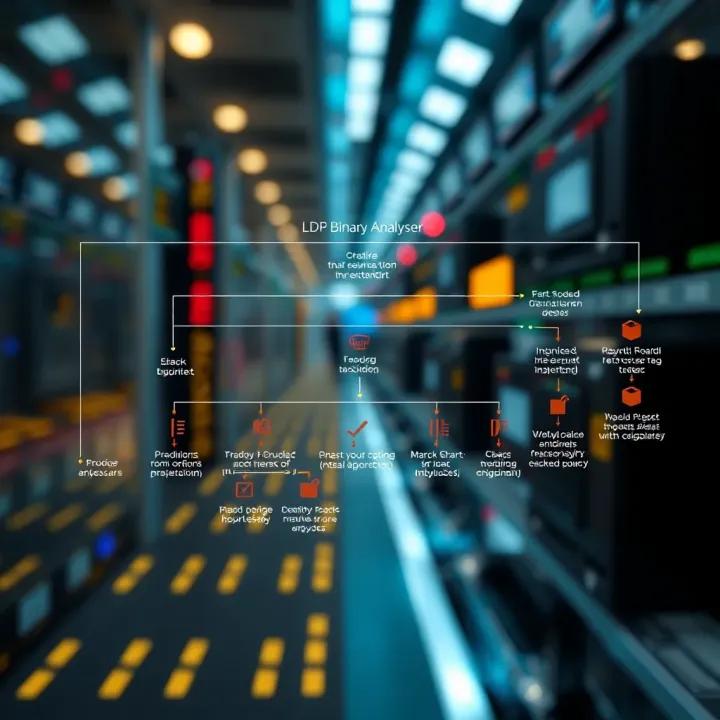
Understanding how the LDP Binary Analyser functions is key for effective network management and troubleshooting. This section breaks down the process of capturing and decoding LDP traffic, then explains how to interpret the labels and message categories you encounter. These insights help you identify issues quickly and optimise label switched paths used across MPLS networks.
Capturing LDP packets involves intercepting the binary data exchanged between routers during label distribution. In practical terms, this means monitoring the network interface where LDP messages flow and using packet capture tools that filter specifically for LDP traffic. For example, you might use Wireshark or tcpdump with filters set to UDP port 646, which most LDP implementations use, to isolate these packets without the noise from other protocols. Correctly capturing packets in real-time or from saved traces ensures you gather accurate data for further analysis.
Once captured, decoding the binary fields in these packets reveals their meaningful contents. The data is structured in a specific format defined by the LDP protocol, typically including headers, labels, and various TLVs (Type-Length-Value elements). Decoding transforms the raw binary into human-readable form, showing label values, message types, and session information. This step is crucial; without properly decoding the contents, misinterpretation can lead to incorrect troubleshooting or network planning. Tools usually use established parsing logic to interpret these fields, but engineers must be aware of different vendor implementations which may cause subtle variations.
Decoding label mappings is how the analyser translates the raw label data into useful network routes. Labels are numeric tags that guide packets on their path through an MPLS network. The analyser shows which incoming labels correspond to outgoing labels across routers, helping you verify correct label assignment and forwarding behaviour. For example, if a label binding is missing or mismatched, the tool flags the issue early, preventing possible packet loss or loops.
Understanding the different LDP message categories further enriches your analysis. Common categories include Label Mapping, Label Withdrawal, and Notification messages, each serving different purposes. Label Mapping messages assign labels, while Withdrawal messages remove them when routes change or are no longer available. Notification messages alert to errors or state changes. Recognising these message types helps you pinpoint exactly what stage of the label distribution process might be failing, making your network troubleshooting more targeted and efficient.
Successful use of an LDP Binary Analyser depends on grasping both the capture and decoding process plus a keen understanding of label dynamics and message types. This lets network engineers make informed decisions based on clear data.
By mastering how the analyser works, traders and analysts monitoring network infrastructure can support faster problem resolution and improve overall performance, which keeps business data flowing smoothly and securely.
The LDP (Label Distribution Protocol) binary analyser plays a vital role in managing networks that rely on MPLS (Multiprotocol Label Switching). It provides network engineers and administrators with direct insight into label distribution mechanisms, helping to resolve issues and optimise performance promptly. By interpreting raw binary data, the analyser reveals what happens behind the scenes in LDP communication, enabling more precise control over traffic flows.
Misconfigurations in LDP settings can cause serious disruptions in label distribution and overall network stability. The binary analyser helps identify these by decoding LDP messages and highlighting inconsistencies such as unexpected label ranges or incorrect label bindings. For example, if a router advertises labels that don't match the configured topology or traffic policies, the analyser shows these anomalies clearly, allowing technicians to fix them before they escalate into outages.
In practical terms, network teams often face scenarios where label advertisement fails silently, leading to routing loops or dropped packets. Using the analyser to decode LDP packets during such events provides a direct way to pinpoint if the root cause is a misapplied setting, a mismatch between routers, or issues caused by firmware or software errors.
Label assignment failure is another problem where the binary analyser proves handy. When a router cannot assign a label to a particular FEC (Forwarding Equivalence Class), it disrupts the forwarding process. The analyser tracks these failures by inspecting error message types and status codes within the LDP binary data stream.
This tracking allows network managers to react quickly when label bindings aren't established properly, which can happen due to resource constraints or configuration conflicts. For instance, if a device runs out of label space or fails to allocate labels for certain routes, the analyser’s output points this out, helping avoid prolonged downtimes or performance degradation.
Studying how labels propagate across the network is crucial for optimising routes and reducing latency. The LDP binary analyser decodes label distribution paths, revealing how labels are assigned along different links. This helps engineers understand whether packets take the most efficient route or if label paths are suboptimal.
A concrete example is when a network has multiple possible label-switched paths between two points. The analyser assists in comparing these paths’ label assignments and detecting loops or bottlenecks. Correcting such inefficiencies can improve overall throughput and reduce jitter, critical for applications like VoIP or video conferencing.
Efficient label switching depends on seamless handoffs between routers along the MPLS path. The binary analyser provides visibility into the exact label values used at each hop and verifies label bindings match as expected. This visibility uncovers potential mismatches or delays in label swapping that slow down packet forwarding.
By examining the analyser’s detailed output, network managers can confirm that label switching occurs without unnecessary processing or resend cycles. For example, in some networks, incorrect or delayed label updates cause packets to be dropped or redirected inefficiently. Identifying and fixing these issues leads to smoother data flows and better utilisation of network resources.
Using an LDP binary analyser is like having a microscope for your network’s label operations — it reveals subtle problems before they grow and guides you to better network health and performance.
Overall, practical use of the LDP binary analyser saves time and money by preventing errors escalating into full network outages and keeps data moving swiftly along their optimal paths.
LDP binary analysers are powerful tools that help decode complex network traffic, but using them comes with its own set of challenges. Understanding these common issues is important for IT professionals and network engineers so they can avoid misinterpretations and get accurate insights from the data. Addressing these challenges improves troubleshooting, security checks, and overall network management.
One common difficulty when analysing LDP data is managing variable-length fields. Unlike fixed-size fields, these can change size depending on the specific message or label being sent. For instance, a label list might vary in length depending on how many labels the router attaches. This dynamic size requires flexible parsing algorithms that can adjust on the fly. Failing to handle variable-length correctly may lead to truncated data or misread information, causing the analyser to give wrong outputs.
LDP uses TLV encoding frequently, and these TLVs can be nested inside each other for more detailed information. Nested TLVs add a layer of complexity as the analyser must recognise the start and end of each structure correctly. For example, a message might include a series of attributes where each attribute itself uses TLVs. Misreading these nested TLVs can produce incorrect label mappings or miss vital network events. Effective debugging depends on accurate interpretation of these layers.
Decoding errors are a common pitfall when working with LDP binary analysers. Misalignment of byte boundaries or wrong assumption about data encoding can lead to seen but incorrect values. A typical error appears when a decimal number is mistakenly read as hexadecimal or when signed and unsigned numbers get mixed up. These mistakes distort the label path analysis and can lead network teams to chase phantom problems.
Different network devices might implement slight variations or extensions to the LDP protocol, which poses a challenge for universal analysers. A label that looks straightforward on one router might encode additional information on another. Consistency in interpretation is crucial for multi-vendor environments common in Kenyan enterprises. Configuring the analyser to recognise device-specific quirks or updating it to cover varied firmware versions helps maintain reliable and meaningful data outputs.
Accurate and consistent interpretation of LDP binary data is essential. A lapse anywhere in handling variable data lengths, nested TLVs, or device differences could cause wasted time chasing incorrect diagnoses.
In practice, engineers often combine automated analysis with manual checks, cross-referencing decoded data with expected network maps. This prevents overlooking subtle data traps within the binary fields, ensuring network management remains efficient and effective.
Using an LDP binary analyser is much more than just running software and looking at output. To get the best from such a tool, you need to apply certain best practices that sharpen the accuracy and usefulness of the data you collect. Effective use of these analysers helps troubleshoot complex network issues, optimise label distribution, and maintain smooth MPLS network operations. This section explores concrete tips that make your analysis both reliable and actionable.
Setting up filters to isolate LDP traffic is essential for efficient data analysis. Since network traffic can be vast and noisy, applying filters specifically for LDP packets narrows down the data to what matters. For example, you might filter based on UDP port 646, which is commonly used by LDP. By doing this, you avoid clutter from unrelated traffic like HTTP or DNS packets, making the captured data easier and faster to analyse. This approach also saves processing resources, which is valuable when working with high-throughput networks like those in Nairobi’s data centres or regional ISPs.
Timestamping and session tracking help provide context to the raw binary data, showing exactly when packets were captured and how sessions evolve. Accurate timestamps enable you to correlate LDP events with other network activities or incidents, such as link failures or configuration changes. Session tracking allows you to follow an LDP exchange from initiation through label assignment to teardown, highlighting interruptions or irregularities. This continuous view is especially important in busy networks where multiple LDP sessions coexist, like in large corporate intranets or major internet exchange points in Kenya.
Applying insights to correct issues means translating analyser data into real network fixes. Suppose the tool shows repeated label assignment failures between routers in Mombasa's ISP backbone. Network engineers can then focus on those devices’ configurations, routing policies, or physical links. These targeted actions prevent broader outages and improve traffic flow across the network. Effective use of analysis results avoids guesswork, often saving hours or even days that would otherwise be spent on trial and error troubleshooting.
Documenting findings for future reference is a step often overlooked but invaluable for ongoing management. Notes detailing what anomalies were found, steps taken to resolve them, and confirmed outcomes provide a knowledge base for the team. This record helps newcomers understand previous challenges and solutions, speeding up future fault diagnosis. In Kenyan companies where staff turnover can be rapid, good documentation preserves institutional memory and ensures continuous network reliability.
Well-applied data capture, precise analysis, and clear documentation turn the LDP binary analyser from a tool into a vital asset that supports network stability, performance, and growth.
By following these practical tips, network professionals and analysts can maximise the value they extract from LDP binary analysers, ensuring they fit well into Kenya's diverse and dynamic network environments.
🔢 Explore binary multiplication basics, step-by-step methods, and its role in computing and digital tech, plus tips to optimize this essential process.

🔢 Explore how binary powers computing—learn about data representation, processing, and storage in hardware and software used every day. 💻⚙️

🔢 Learn how decimal to binary converters work, their role in computing, manual methods, handy online tools, practical applications, and simple programming guides. 💻

🤖 Explore bot binary systems—how they work, industry uses, security risks, and tips to find and manage them. A clear guide for tech and cybersecurity enthusiasts.
Based on 8 reviews